Educational guide · 2026

Investment in gold - 2026 guide

Physical gold, coins, ETFs and futures. A complete comparison of forms, tax advantages and where to buy in the Czech Republic.

4Investment Options 3 years. Exemption test 75-85k. Price per ounce 2026
Investment gold coins and bars. Updated · 2026

Educational character. This article is for educational purposes only and does not constitute investment advice. All information is of a general nature. Before making any specific investment decision, consult a financial advisor.

Overview

What you need to know

Gold is among the oldest and safest investments. Over millennia it has served as a store of value and a means of preserving wealth during economic downturns. This article explains why gold is important for an investment portfolio, what forms of investment exist and how to deal with it in the Czech Republic.

Why is an investment in gold important

Gold plays a critical role in an investment portfolio as a diversification element. While stocks tend to fall significantly during financial crises or periods of high inflation, gold usually rises. Historical data shows that over the past 20 years, gold has delivered an average annual return of around 7-8% while serving as a hedge against inflation and currency crises.

Inflation in the eurozone reached a peak of 10-11 % in 2022-2023, when the list price of gold in euros fell by more than 30 %. For Czech investors this means a double effect: rising gold prices plus appreciation against the weaker koruna. Gold is also the only asset not dependent on the profit of a specific company or the economic situation of one country, its value exists independently of geopolitical events.

Physical ownership versus intangible forms

Physical ownership of gold (coins, bars) means you have direct control over the asset in your hands. It requires no financial intermediary. The price of physical gold is always 2-5 % higher than the spot price (daily current price) due to production and distribution. Intangible forms, ETFs, futures, mining company shares, offer greater liquidity and lower purchase costs, but you are not the owner of physical gold.

The choice between physical and non-physical gold depends on your strategy. Conservative investors who wish to hold gold indefinitely and value physical ownership should buy bars or coins. Speculators who monitor prices daily and aim for lower trading costs prefer ETFs or futures.

Historical performance of gold (2000-2026)

Since 2000, the price of gold has risen from ~250 dollars per ounce to the current ~2 200 dollars. This represents an increase of more than eightfold over 26 years, equating to approximately 8-9% annual return without dividends and without the need for reinvestment. Notably, during periods of low interest rates (2010-2019) and especially during the pandemic (2020-2021), gold reached its historical highs.

For the Czech investor, it is important to know that the price of gold in Kč is even more volatile due to exchange rate fluctuations between the koruna and the euro. Gold therefore serves as a hedge against inflation in koruna and against foreign currency risk.

Tax advantages of physical investment gold in the Czech Republic

Czech tax legislation provides a unique tax benefit for physical investment gold. If you own physical gold for more than 3 years and then sell it, you are not required to pay income tax on the gain. This is a fundamental difference compared to shares, real estate or silver. The condition is that you must be in physical possession of the gold (not via share certificates or futures).

Silver, on the other hand, is subject to 21 % VAT, whereas investment gold is exempt from VAT altogether. This makes gold the most tax-efficient form of investment in the Czech Republic. The combined savings on VAT and income tax when buying and selling gold for 1 million Kč amount to tens of thousands of Kč.

Risks and limitations of investing in gold

Gold does not generate cash flow (it pays no dividends and is not backed by any product). Its price is purely speculative, driven by supply and demand. During periods of sustained economic growth and high interest rates (see 1980-2000), the price of gold fell.

Physical gold carries the risk of theft. Home storage requires a high-quality safe (5-20 thousand Kč). Bank safes cost 0.5-1% of the value per year. Selling physical gold is time-consuming, sellers in the Czech Republic take a margin of 2-5% and the process takes at least several hours.

Another risk involves counterfeit gold. If you buy gold online, there is a small (but real) risk of a fake. Counterfeits are physically difficult to identify without laboratory testing. It is therefore important to buy gold from a trusted source with a certificate.
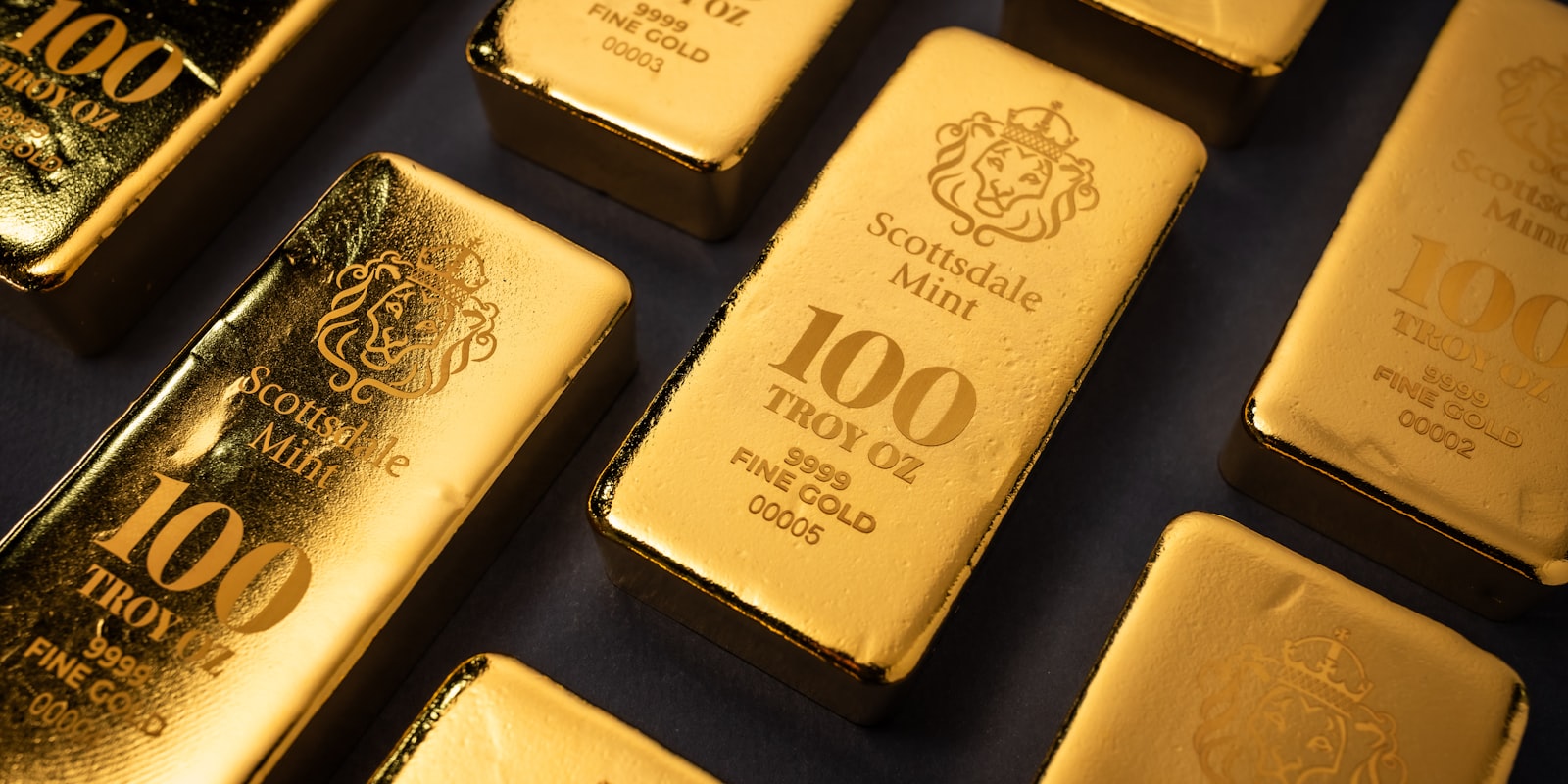

Comparison of forms

Four paths to investment to gold

01 · Physical

Ingots and coins

You buy physical gold in grams or ounces: typically a 1-50g ingot or a well-known numismatic coin. Storage at home in a safe or in a bank vault. Advantages: tax exemption after 3 years, absolute ownership. Disadvantages: high storage costs, narrow spread (2-5 %), slow sale.

02 · ETF

Investment funds (online gold)

You are purchasing a share certificate of an ETF fund that holds physical gold. Examples: iShares Gold Trust (IAU), SPDR Gold Shares (GLD). Advantages: low costs (0.2-0.4 % per year), good liquidity, easy to sell. Disadvantages: you do not own the physical gold, income tax upon sale, it is a digital asset.

03 · Miners' Promotion

Action of the gold mines

Investment in gold mining companies (e.g., Barrick Gold, Newmont Mining). Advantages: potential for higher returns; corporate reports and fundamentals can be analysed. Disadvantages: higher volatility, dependence on company assets, income tax (12%), more complex analysis.

04 · Futures

Scheduled contracts (advanced)

Speculative purchase of future gold prices on the Comex or LBMA exchanges. Advantages: lowest costs, huge liquidity, leverage (investment with borrowed funds). Disadvantages: extreme risk (you can lose more than you invested), income tax, requires a broker's account.

05 · Share certificates

Gold storage funds in the CSSR

Czech mutual funds (e.g., Česká spořitelna Gold Fund) hold physical gold in vaults in the Czech Republic. Advantages: easy purchase via a domestic bank, insurance coverage, income tax applies. Disadvantages: higher fees (0.8-1.5% per year), less liquidity than foreign ETFs.

06 · Crowdfunding

Shared ownership (alternative)

Platforms such as Affinity or Goldify allow you to buy a share in physical gold (from 100 Kč). Advantages: low minimum investment, easy sale, insurance. Disadvantages: crowdfunding fees (2-4 % per year), less transparency, newer segment.

Practical advice

Where to buy gold in the Czech Republic

The Czech Mint: the largest seller

The Czech Mint (česka-mincovna.cz) is the official producer of Czech euro coins and the largest seller of physical gold in the Czech Republic. It offers investment bars (1-100g), gold coins, and well-known world coins. Prices are accurate and standard (spread +3 %). Online ordering, collection in Prague or Brno, or postage available. Collection times: 2-5 working days.

Argor: high-quality Swiss gold

The company Argor (grupo-argor.cz) manages Swiss gold bars and well-known brands (Argor-Heraeus). Quality guaranteed by certificate and serial number. Prices: higher spread (+4-5%), but absolute certainty of purity. Ideal for conservative investors who want bars with a guarantee.

IGR and other local retailers

IGR (ingot retailer) is a specialist in the sale of investment gold without VAT. Silver and gold ingots, certified, with buyback. Standard spread (3-4 %), prices updated daily. Physical location in Prague (Nové Město), online ordering with courier delivery.

Czech banks: KB, ČSOB, Moneta

All major Czech banks offer the purchase of physical gold. Advantages: security, insurance, easy storage in a bank safe. Disadvantages: higher price (spread +4-6 %), higher storage fees (1-1.5 % per year), less selection. Ideal if you want to keep gold in a bank vault.

Online shops and iAntar

A number of online shops (e.g. IAntar.cz, zlato.cz) sell physical gold and silver. Competitive prices, huge selection. Risks: transport security (I recommend an insured courier), counterfeits (check the certificate). When buying online, always verify reviews and certificates.

Foreign purchases: BullionVault, Goldmoney

BullionVault and Goldmoney platforms allow you to buy physical gold stored in foreign vaults (London, Zurich, New York). Advantages: best prices (spread +1-2 %), high liquidity, insurance. Disadvantages: digital ownership (not physical), currency risk, more complex tax record-keeping. More suitable for speculators.

Property maintenance

Where and how store Secure gold investment

Home safe: the most common choice

Purchasing a quality home safe (5-20 thousand Kč, depending on size and equipment) is one of the simplest solutions. The safe should have at least security class EL (electronic lock with battery) or higher. Remember to note down the password outside the household, losing the password means very expensive opening.

Advantages: full control, no storage fees, quick access. Disadvantages: theft risk, home insurance must be extended (typical limit is ~50 thousand Kč), contents safety not guaranteed in case of fire.

Bank vault: secure but expensive

A safety deposit box at your bank costs 0.5-1.5 % of the contents' value per year. For 100 thousand Kč in gold, this amounts to 500-1 500 Kč annually. Advantages: professional security, insurance, access during set hours. Disadvantages: high annual costs, no access outside bank opening hours, and you are not safe in the event of the bank's bankruptcy.

Private safes: third option

Some companies (e.g. SafeBox, Golden Gate) rent out private safes without being tied to a bank. The price is comparable to banks (0.75-1.5 % per year). Advantages: flexibility, 24h access, less bureaucracy. Disadvantages: lower company recognition, insurance may be weaker, higher risk of theft.

Storage at the retailer: a secure strategy

When purchasing physical gold, you can leave it in safekeeping directly with the seller (e.g., Česká mincovna, Argor). Price: 0.5-1.5 % per year + possible insurance premium. Advantages: automatic insurance, storage certificate; buying/selling is immediate when needed. Disadvantages: tied to the seller, market risk (if the seller goes bankrupt).

Frequently Asked Questions

What you are asking about most frequently

How much does 1 ounce of gold cost in 2026?

In April 2026, the price is around 75-85 thousand Kč per one troy ounce (31.1 g). The price changes daily according to the current rate on LBMA (London Bullion Market Association) exchanges. You can track the price in real time on sites such as Trading View or XE.com.

What is the advantage of gold over stocks?

Gold acts as a diversifier, during crises and inflation it typically rises while stocks fall. Historically, gold has delivered returns of ~7-8 % per annum over the long term (20+ years). Unlike stocks, it requires less time for monitoring. When you own a stock, you must track the company's profits. Gold only needs storage.

What is the minimum investment in gold?

The minimum investment is practically unlimited. You can buy individual coins (1-5 g for 2-8 thousand Kč), or invest via ETFs or crowdfunding from a fraction (hundreds of Kč). Physical gold is usually sold in units of 1, 2.5, 5, and 10 g. For beginners, I recommend buying 10-20 g to test the storage process.

Am I required to pay income tax when selling gold after 3 years?

No. Physical investment gold is exempt from income tax if held for more than 3 years. This is an advantage of Czech legislation. Silver carries a 21% VAT, whereas investment gold has no VAT at all. At that time, economists say it is the most tax-efficient form of investment in the Czech Republic.

Where can I buy gold online in the Czech Republic?

Main dealers: Česká mincovna (ceska-mincovna.cz), Argor, IGR, Banco-aurum, Miland, Czech banks (KB, ČSOB, Moneta) and online shops (iAntar, zlato.cz). All offer online ordering. Physical collection usually takes 2-5 working days. I recommend verifying reviews and certificates.

What are the annual costs of storing gold?

Bank vault: 0.5-1% of value per year (for 100k Kč = 500-1,000 Kč). Home safe: one-off investment (5-20 thousand Kč). Private safes: 0.75-1.5% per year. Custody with the seller: 0.5-1.5% plus insurance premium. Uninsured home storage: free, but risky.

What percentage of your portfolio should be in gold?

Financial advisors recommend that ordinary investors hold 5-10 % of their portfolio in gold. For more conservative individuals with a long-term horizon (20+ years), up to 15 %. The exact percentage depends on age (younger = less gold), risk tolerance and other investments (real estate, bonds, shares).

Further educational guides

Next guides in the cluster

Investing is a complex field. Are you interested in pension savings, loans for self-employed individuals or other financial products? Explore further guides.

Return to the home page